
Jackson Pollock
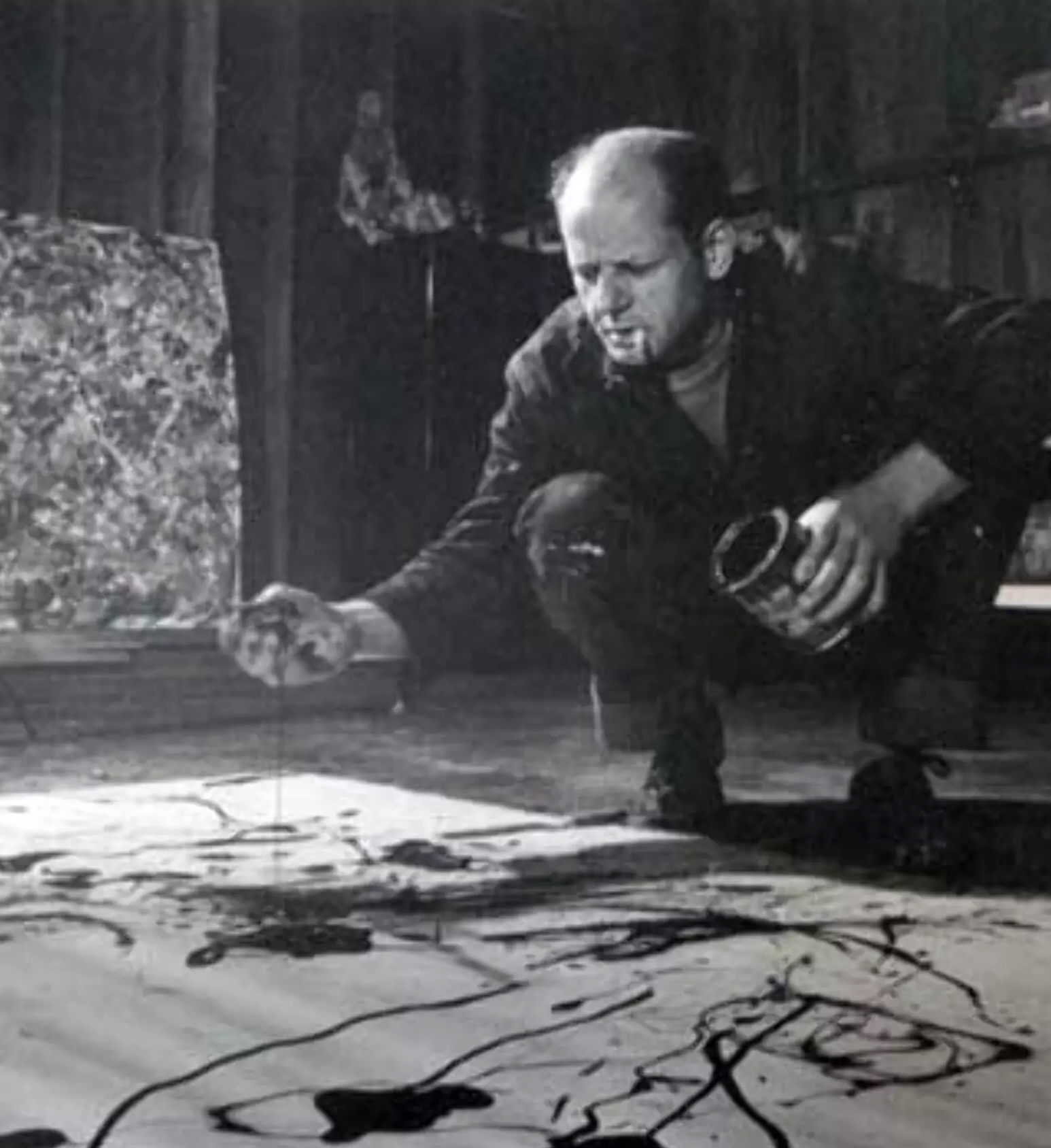
Pollock in his studio
There is value in trying to explain why one work of art works and another doesn’t. Arguments like these aren’t something you ‘win’. They are matters of opinion. What matters is the act of thinking about the work and articulating why you like or don’t like it. This act forms the basis of personal taste.
As a group, we humans can let our check books back our opinions. In the art world, dollar amounts often become a substitute for criticism. A painting sells for $20 million, then $50 million, then $100 million, and the price begins to behave like a verdict. The market tells us that a work matters, but not why. It confers importance while relieving everyone of the burden of explanation. This has become a problem for people who care about art when they are talking with people who don’t know anything about the art market. It’s hard to answer the question “Why is that painting of polka dots selling for $1 million?”
Jackson Pollock is apparently about to have his third painting sell for more than $100 million, and I want to call BS.
17A 1948 - $200 million private sale
Pollock is an important artist. There are a handful of moments in Western art when the conversation changes. In the twentieth century, three of these moments come to mind for me: Picasso’s Les Demoiselles d’Avignon in 1907, Duchamp’s Fountain in 1917, and Pollock’s drip paintings from the late 1940s.
Each of these works helped rupture an idea of what art was supposed to be. Picasso started down the path of Cubism. Duchamp added a dimension to all artwork by welcoming Conceptual thought. Pollock turned painting into an arena of action and gesture with Abstract Expressionism.
Pollock’s work became attached to larger questions about freedom, American cultural power, and the role of the artist after World War II. Modernism increasingly treated mastery with suspicion, as though the skill to paint a recognizable subject somehow contaminated authenticity.
The cultural influence of Pollock is undeniable. By the 1950s and 60s, art schools were producing wave after wave of abstract expressionist painters working in a visual language that often felt interchangeable. Looking through art magazines from the period, you encounter endless variations of work following the same strict Clement Greenberg guidelines.
To me, this American ‘freedom’ that Pollock represented created a self governing movement that was incredibly rigid, stifling, and long-lasting. It got to the point where you can point to artists like Diebenkorn and Guston and see how they wrestled with either being successful Abstract Expressionists and exploring figurative painting which was so far removed from the contemporary art world at the time, people questioned if what they were doing could even be considered ‘art’.
What still fascinates me about Pollock is not the paintings, but the photographs and films documenting him at work. Pollock circling the canvas with a cigarette hanging from his mouth became one of the defining visual myths of twentieth-century art. That may be Pollock’s real achievement, he helped create a new image of the artist: the painter as existential performer, the canvas as receipt.
Cliff’s Verdict on Pollock:
(Pollock is a hack and my opinion wont change)
Pollock matters. That is not really in dispute. His drip paintings helped alter the course of twentieth-century art, and the major canvases deserve to be treated as historically significant objects.
What I struggle with is the insistence that these paintings necessarily reward prolonged aesthetic contemplation independent of the mythology surrounding them. Outside of what they represent conceptually, I find the paintings themselves to be far less compelling than the cultural transformation they helped authorize.
I also struggle with the idea that purchasing one Pollock drip painting means purchasing that single transformative moment in art history. There is one Les Demoiselles d’Avignon. There is one original urinal represented by Duchamp’s Fountain. But there are roughly 160 Pollock poured or drip works from the late 1940s and early 1950s, and the market seems willing to treat each as though it represents the whole historical event.
If I walked into someone’s house and saw a $100,000,000 bill framed on the wall, I would stop and contemplate the implications of that for a minute. But I would not be contemplating the beauty of the bill. I would be contemplating the fact that someone had enough money to turn money itself into décor.
That is how these Pollock sales feel to me. The painting is still there. The history is still there. But at a certain price, the object starts to function less like an artwork and more like a framed certificate of wealth. The drip painting becomes a receipt for cultural significance.