
Nina Chanel Abney
I like the work of Nina Chanel. Recently I came across her work for the first time when I picked up an issue of Juxtapoze where she was featured.
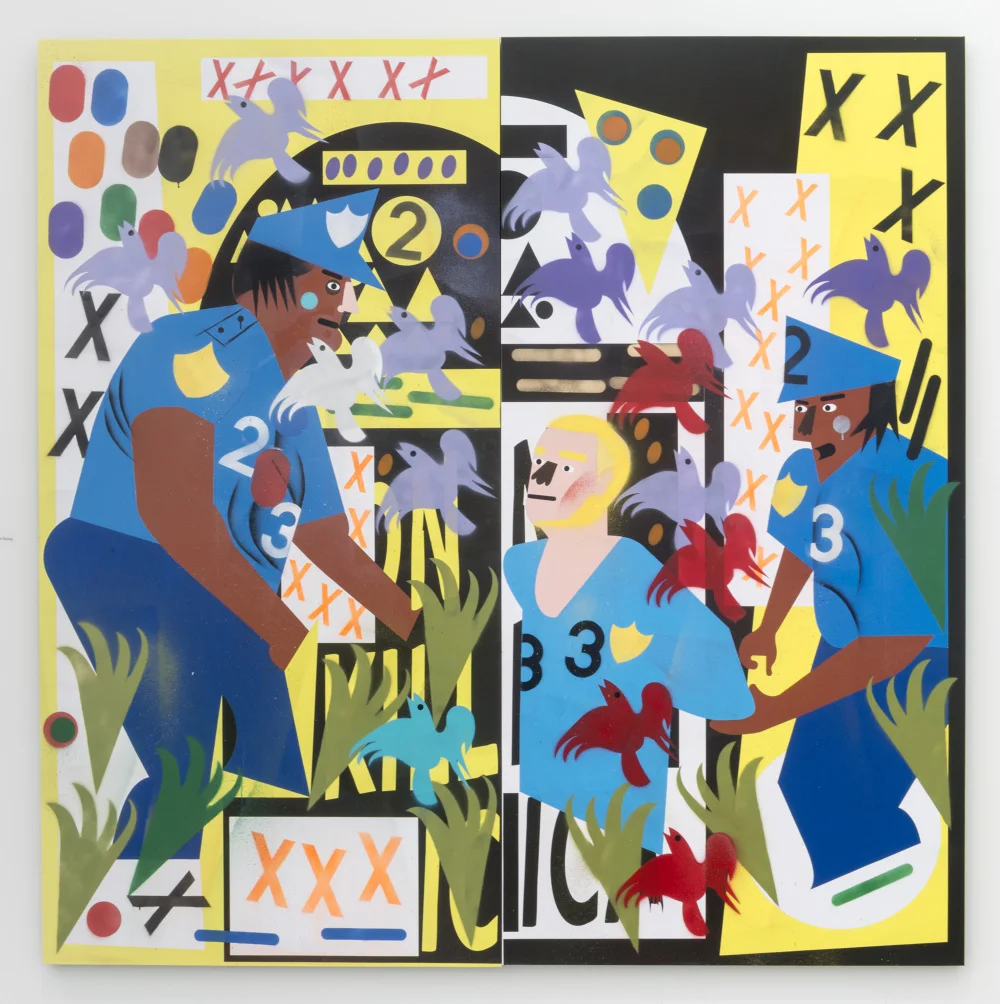
Abney - 'unknown title'
What struck me was the way she seemed to be influenced both by the work of Basquiat and Stuart Davis.
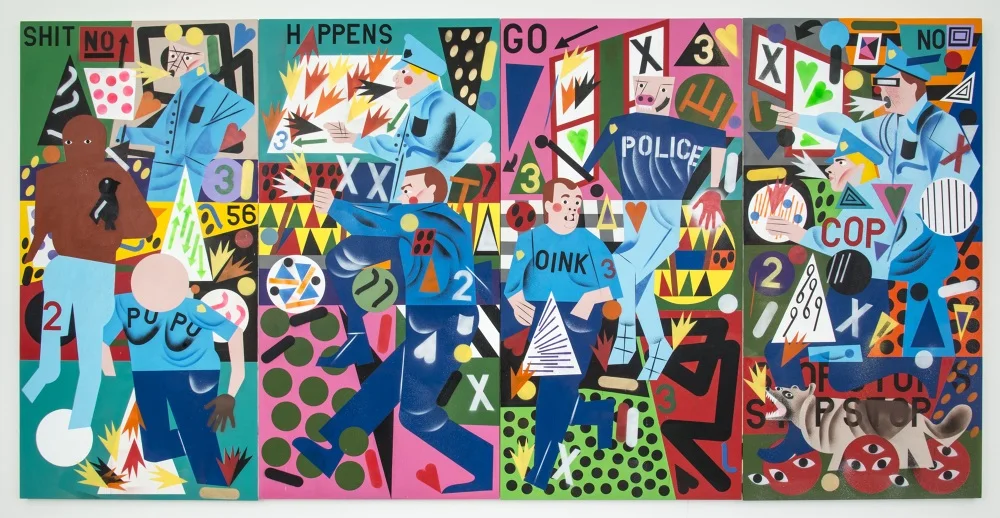
Abney - 'Why'
Looking at Abney's work in detail in order to see how she does it, it looks like she is using spray paint and stencils. While I have nothing against this medium, and believe that this style suites her work well from afar.

Abney - 'Detail view'
So two thumbs up for the vibrant colors and composition. I’d like to see it in person in order to judge the tactile nature of the work. I hope it is not flat.
<br><br><br><br><br><br>
<h1>RAW TEXT BELOW</h1>
<br>
NOTE: All of this was from the transcript and is left in an unaltered form so people can fact check if w
<br>
Well, my mother had gone to college to become a teacher, and I can tell you more about my father. You know, he had been born in Sweden, and his parents came to America, and she was pregnant with their second child when they crossed the ocean to come to America. And they got to New York, of course, and then they went by train to Minnesota, to a town named St Cloud, and they stopped there for two weeks, and the next baby was born there. So now they had a toddler, a two year old, who was my father, and now they had another little child, I think, a girl. Well, they bought a team of oxen and a wagon, and they continued on their trip to the land they had chosen near Alexandria. And they, I suppose, camped in their wagon while the grandpa, my grandpa, would have been built a log cabin for them to live in. And I can't imagine, you know, two little children living in a wagon because, of course, there weren't any grocery stores except in Alexandria, but they didn't go there very often, and I can't imagine, you know, how they would have lived, but they did, and after the log house, then they built A big farmhouse, and that's where they were living when their children were growing up. Well, many my dad, when he got to be old enough, got a job on what they called a bonanza farm in the Red River Valley there, as soon as you know the train came out that far, then rich people would buy up land, and they would hire big crews of people. To take care of that land, and one where my grandpa, my father, worked on, belonged to some people from Minneapolis, and they recognized that my father was quite an intelligent man, and they encouraged him to come to Minneapolis with them in the winter time and Go to school, which he did. He went to an academy and he went to a business school. So he got quite an education that way. Well, then his father was getting old, and most of the children had left home and gone out west, some to Montana and some to Washington. And the old John E was left alone pretty much, and he wanted my father to come home and farm that land that he had. And I guess dad agreed to that. And it was after that that dad got married to his first wife, and then she passed away, and then he was on some and that's when he met my mother. Does that explain a little bit of it
My father had beautiful handwriting. you know, that was something that was encouraged, that children learned how to write carefully, and both my mother and father had beautiful handwriting, and they both liked to read I grew up in a home where everybody liked to read. We had a lot of books of our own, and we borrowed books at the library, and books were always in. Important part of our family.
There was one bedroom where the boys slept, like Walter and Oscar and Russell and there were room for two beds in that room. And then us girls, Marie and Edith and I shared, well, Marie and Edith shared a bedroom. And when I was very little. Of course, I slept in the same room as my mother and father, but then when I got a little older, then I shared the room, the big bedroom, with my sisters, and we always had one bedroom that my mother kept ready for company, because people would come to visit and stay overnight, and she had had a guest room that she always kept in order so that There would be a place for them to sleep. Now, we did not have electricity because the government hadn't provided for that until after World War Two, and so as long as we lived on the farm, we did not have electricity and we did not have running water. We had to carry in all the water that we used. We had to heat it on the stove or keep it as cold as cold as we could for drinking, and so there was a lot of work to be done.
There were two floors. And of course, a stairway leading from one room downstairs to the upper floor. On the upper floor there were, there were three bedrooms and a very large closet and this stairway, and then on that, on the ground floor, or the first floor, there was a large living room and a dining room and a kitchen. And then there was one very large bedroom that my parents slept in
and in the. Living room like I'm imagining you had, like a bookshelf with books. My dad had a beautiful desk that had been made for him, and it was one of those old roll top desk, and it had a bookcase with three shelves on the desk, and that bookcase was was full of his books. And then there was another smaller bookcase where us kids kept our books, and when I couldn't be found, they would always come and look in the living room, because I would be sitting on the little bench reading a book from that little book. We went down there in that room in the evening, and we had what was called a parlor organ, and my sister Marie knew how to play the organ. And we would get together the whole family, and we would sing once in a while. We all knew all like to sing, and so we would gather around the organ, and Marie would play it, and we would sing our favorite songs. Us kids, of course, would play board games, and we would just kind of sit on the floor, on the carpet and play games on the floor, or sometimes we would sit at the dining room table and play board games, and we had quite nice furniture in the living room. There was a big couch made of oak wood with leather upholstery, and it had a matching chair and a rocking chair. And dad had his favorite rocking chair, and mother had her favorite chair.
There was a large it was a cement porch, and there was one door out to it from the dining room and one door in. From the kitchen, and we would, you know, in the summertime, especially, we would sit out there and play games, or visitors might come and sit on that porch and visit mother always had the coffee pot on wood sweet. She always, when we get company, she would always have coffee and some kind of lunch, probably a cake or cookies or something, and eating was an important thing in those days, we always had a big garden. My dad was knew about, you know how and when to plant things, and so we had a big garden show in the springtime. We would have fresh lettuce and radishes and onions, and then, as as December went on, we would have peas and green beans and carrots and tomatoes and watermelon. So we ate. It's very healthy. That last farm that we lived at had 160 acres. and there would, Dad would plant wheat and corn and flax and rye, and then, of course, part of the land was pasture where the cows and horses could eat the grass. So there was part pasture and part field on the farm.
I was about two years old when to that farm, parents had lived on a bigger farm, not too many miles away, but in deep prey the 20s and 30s, the farm did not produce enough, but so the farm was taken back by the bank, and then we moved to this other farm that my my mother's parents owned already. So the house that I lived in and the farm I lived on was a farm that my grandparents owned. A
wished? He was tall and never did get fat, but he was, you know, he was quite a big man, and he had, he had beautiful white hair, and that's kind of interesting too, because when my mother met him, he had beautiful, dark brown, wavy hair. Well, at the end of World War Two, one, when that flu epidemic was going around. My father was very sick with the flu, and as a result of that, his beautiful hair turned Snow White, and it never did get dark again. I remember as a kid, I thought my father had very large ears. You know, you remember some of those silly little things. And I thought Dad had pretty big ears, but he, of course, had whiskers and shaved every day, and had to shave with a brush and a razor and some soap and be Very careful so he didn't cut himself. It was very important to him that we all should be very clean, and so taking a bath was a regular thing, even when we were short of water, we always had. Wore clean clothes and we we kept our bodies clean. And like I said, Dad liked to read. I remember him reading stories to me when I was a little girl, and he had had breathing difficulty called asthma, where he would find it very hard to breathe, and so he wasn't able to work as hard as he would have liked to, but then he would get feeling better, and the work would get done. And of course, Walter and Oscar were still at home.
They went to.
—-
Nanny was very pretty. She had pretty dark hair.
But she had pretty dark hair and a very nice complexion.
She was not very tall, I suppose she probably was about five, four, something like that. And she liked to sing. And oh, another thing about both of my parents, they were very religious.
We went to church every Sunday. Us kids went to what was called Sunday school, and my dad read his Bible every morning, before any of us got up, he would sit at The dining room table and read his Bible by lamplight, and that was very important to him.
If my mother taught Sunday school for many, many years, you'll have to ask your mom what what Sunday school was, because she would remember and be able to tell you, okay, but
going to church was extremely important in our family.
So let's see.
And I said, my mother liked to sing, and she encouraged all of us kids to sing, and some of us did get to be quite good at singing. And I remember I sang solos at people's weddings, and I sang in church, and I sang in the choir at high school and in college.
Music was was very important. Mom was a pretty
good cook. We ate. We ate very well.
What kind of food did your mom make? Like I'm imagining Lu to fest all day, every day. Well, we had
ludafisq Fish in Christmas time, of course, and then my dad and mother made something that we called potato sausage.
We would they would mix up a mixture of ground potatoes, ground beef and ground pork. And then there were some spices in it, and that would get all mixed up and stuffed into sausage tastings.
And then to prepare it, you would boil it in a kettle of water for about half an hour, and then we had hot potato sausage, and that was something we always had at Christmas time.
And there are still a few meat markets around
that big potato sausage, and there is one in Evansville that still makes it. So every year at Christmas time, I get some potato sausage
from the Evansville Meat Market sounds good.
There was a lot of fruit. Of course, apples and choke
cherries. Well, of course,
we had to buy peaches because they didn't grow. Peaches, because they
didn't grow around Minnesota, but peaches and pears and my mother would would buy creams of that fruit and preserve it, so we would have have shots to eat in the wintertime when there wasn't
fresh fruit.
My mother had wanted to be a nurse when she was growing up, but her mother thought that she should be a teacher, and that's what she was, but she had taken some nurses training, and so when there was a baby born in the neighborhood, they
would call my mother and Ask her to come over and help take care of the new baby and the mother, until the mother got strong enough to do that, so
she was very often gone to a neighbor's house Taking care of somebody that had just had a baby, and of course, back then, all the babies were born
at home. Wow. So how big was community around Evansville? Were there a lot of friends or families that you were close to. Oh, yeah,
you always were, you know, you got to know your neighbors, because everybody lived kind of on a small park like we did,
and neighbors would go to visit each other.
I remember we used to go over to visit Mary's grandparents, who lived a farm very close to us, and they were musical too. And so
Mary Mary's mother would play the piano, and we would all enjoy the music. And music was an important part in a
lot of families, and then, oh, there was another family in the neighborhood where
we went to visit that it was a family of all girls, and I had a couple of good friends there that we used to play dolls together When we were little, and we would go to visit them, and all of the moms usually had something special. They would make us a treat to have with coffee. So we would
always have a good lunch when we went to visit someone.
And very often we would walk over to visit because, you know, it wasn't that far from one farmhouse to another one. We did not always have a car that would run very well. And so we were used to walking to places where we wanted to go.
And these also would be your friends from school, right? So like the house with all the girls, yeah, so you were all very close.
Charlie was another
oldest, of course, and he was, he was from
my dad's first marriage, and he was tall
or looking young man, and of course, quite a bit older than the rest of us. And
when he got married, he got married quite young, and he and his wife, whose name was Gail, lived in St Paul, and Charlie had a job as the night manager of a very important restaurant in St Paul, and so he worked at night and was home and slept during the day.
They lived in St Paul all the rest of their life, and they would come up to the farm in the fall,
especially to go hunting, to go pheasant hunting.
And it was always fun when they came up from from St Paul, because they would bring a lot of good food, fresh fruit. And his wife was a wonderful cook, and she would help mother prepare food, and the men would go out hunting. All my brothers liked to go hunting, and one of my brothers had a hunting dog, a little cocker spaniel dog named spotty, and he would, he would chase up the pheasants and get them ready for the boys to shoot them. And then, of course, we would have roast pheasant to eat
during the weekend and at Christmas time, there would always be an exchange of gifts. They didn't, of course,
come home at Christmas time, but we would send a box of things down to their house, and they would send a box up to our house.
Well, mother, Dad would put things from the farm in the box they got there would always be a dressed Turkey, there would be several pounds of butter, there would be some of that potato sausage, and then there would be some presents. And I always thought that was kind of a silly box, because that was stuff that I knew about, and I didn't think was very exciting, but they thought it was wonderful, of course, to get this stuff from the farm. Well, in the box that they would send up to our house, there would be our house, there would be presents for mom and dad and one for me, and then there would be all kinds of fresh fruit and celery and head lettuce, because those were things that our stores did not have on hand. So I learned to eat
celery and lettuce and oh, there would be Christmas candy in the box.
And I just thought that was such an exciting box to get.
Charlie was was very good to us kids. Whenever any of us wanted to go to the city to visit or do something. We always stayed at their house after they had moved into a house, and he would take us around the city and show us all the important places.
I remember one year I was down there, and we went to the state fair when I was oh, I wasn't even 10 years old yet, and I thought that was about the most exciting thing I could have done.
They had one daughter who was about a year younger than I was, and so I would, I would play with Gail, with the daughter, and and then when Charlie had time off from work, he would drive around, and we went to the state capitol and looked at that and all those other important to Fort Snelling, which had been a wilderness fort for many, many years and is still preserved as historic spot.
So Fort Snelling was very interesting.
And as I say, Charlie was was almost like a dad to us younger ones, because he was so so good to us. we kept in touch all
through his life. And we would visit back and forth, and they would come up to, you know, our community, and, oh yeah, we kept it in very close touch to them all through the years.
Walter, Well, he was my big brother.
We spent a lot of time together. I he would, would tell me stories and talk to me. He was, he was a good big brother.
And after he and Pearl were married, I used to baby sit for them. So I baby sat your mom when she was a little girl.
he would always at that
time, he would always pay me a little bit extra for taking care of the kids, so I would earn a little bit of money that way that I wouldn't have had
otherwise.
There was an old Mint hotel that used to have stage coaches come by. I used to
babysit. I Babysit them when they lived there.
And then, of course, they were divorced, and Pearl and the
children later moved to Alexandria, but we always kept in touch, and the girls would come out and visit at my sister Edith's house, or my Sister Marie, and even even at my house after I was married, I remember Mary and Nancy coming in. Each of
them spent a week with me and my husband at our house in Morris, and it was just so much fun, and we went to their their confirmations and their graduations, and kept track of the Girls, kept in touch with them all through the years, and it's been so much fun to know Nancy, Mary and Betty. And of course, our Mary and Nancy.
I was born in 1928. I was unexpected, the youngest of our family. It was the end of the financial bust of the 1920s and the beginning of the depression of the 1930s and another child was not really what my parents needed, but here I was, and they took very good care of me.
I had, I had all these older brothers and sisters, and the one I was closest to was my brother, Russell. He was about three years older than I was. We played together, sometimes helped each other, and went to school together in a country school that was about a quarter of a mile from our house. It was a school where the teacher had all eight grades, from first grade to eighth grade. I had learned to read before I went to school, because my parents read to me a lot, and I caught on on how to read. So in first grade, the teacher asked my parents if she could put me in second grade because I knew how to read and I knew all my numbers facts.
So I took first and second grade in one year, and eventually graduated from eighth grade, and then I went to school in Evansville for my four years of high school. We started out with a class of about 27 or 28, and due to the war and boys needing to help at home, we ended up with a class of 12 when we graduated. I was top student of My class, so I gave a speech at graduation.
We lived on this farm that had the biggest hill in the community, and in the wintertime when there was a lot of snow, that's where all the kids got together. We went coasting and tobogganing and skiing. On Sunday afternoons there would always be a crowd of people up on the hill. Well, then we were cold and wet and whatever we would go to the house, and Dad would make a big pan of popcorn for us, and we might play some games around the dining room table. So that was some of what we did for fun.
And of course, being a little girl, I always played with my dolls, and I had what I called a playhouse out under the trees, and I would play there, and sometimes some neighbor girls would come over and play with me. So we had a lot of fun.
One year (1936) I wanted to know so badly for Christmas. I had been playing with my sisters dolls. And that year I wanted a doll of my very own. Money was very, very scarce, and my mother tried to explain to me that maybe there wouldn't be enough money for a doll.
Well, I had picked out a doll in the catalog that I wanted, and I had a name for her. She was going to be Patsy, and I knew what I would sing to her and the stories I would read to her. And Christmas came, you know, was in December, and I was really looking forward to this doll, and I knew that there wasn't any extra money for one the doll that I wanted cost 98 cents (That was a lot of money back then), and when Christmas Eve came and we were opening our presents, here there were two boxes with my name on them, and one was a doll that My mother and my big sister had made for me, and they had made a quilt. And the other one, lo and behold, was Patsy from the catalog. My big brother, Charlie, lived in St Paul, and he had gone to the Montgomery Ward store and found the doll that I had picked out, and he sent it to me for Christmas.
So then, instead of one doll, I had two of them, and I took very good care of them.
My father was born in Sweden, in the province of WestmanLAND. It was a northwest of Stokholm. When I was 50 years old, my sister Edith and I went to Sweden, and we actually found a farm where my father had been born. We stopped in a little town and asked if anybody had ever heard of the Norgren name. Oh, my goodness, a lady in the store said, there's even a road called Norgren road, and she offered to drive out there ahead of us and show us the way out to the farm where my Father was born.
Well, then we got there, and there was a lady living on a house close by who was sort of the community historian, and she said, Norgren I think there's a letter here from John Norgren telling about America, and she went and found this letter, which, of course, was written in Swedish, but my sister could read and write Swedish. So we we read it and found out, you know, all about their trip from from Sweden to America.
We made a copy of the letter, and I was telling Mary that I had used it for a part of an invitation to a family reunion with our northern relatives. And when I find it here, I will send Mary a copy of that letter, because it tells all of us their trip from Sweden to England, then they went across England and got on a boat and came to New York. And then when they went by train to Minnesota, and then in St Cloud, Minnesota, they stopped for two weeks while my grandmother had another baby.
Well here then, after two weeks, they bought a team of oxen and a wagon, and they drove the 100 miles from from St Cloud up to Alexandria, and there they found land that my grandfather had picked out, and eventually they built a log cabin, and that was where they lived for a number of years.
My grandfather's name was John, Eric Norgren, and my father's name was John, J O, H N, John Abraham Norgren, and he met my mother when she came To teach school in the district where they lived, and he found while he was on the school board, so he found many reasons to come over and check on the School and eventually he and my mother were married and had this big family of seven.
My dad had been married once before, and his first wife passed away. Well, had one one son called son called Charlie, the one who later on gave me the Zell. And then Mom and Dad had six more children, so they had a big family to provide for and after a number of years, they moved up to the farm where I was born, near Evansville, Minnesota, And we lived there until my father died in 1942 died in 1942 and next year, mother and I moved into town, and that's when I was going to high school.
<i> NOT ADDED TO STORY My mother was born in Sweden, and her name was her name was Carrie Borg, B, O, R, G and her father and An older sister had gone from Sweden in farmland to America one year, and they found a place for the family to live, and they found a farm that they could have. And then the next summer, they had enough money, so they sent back to Sweden for the mother and the rest of the children to come.
Well, my grandmother was 16 years old at the time, and her mom got she sick on the way over to America, so my grandma had to take care of the rest of the family during the trip, and I really Don't know much about how they got from from New York to Minnesota, but I imagine there were, there were travel people that helped make those arrangements. And so then that summer, they got to up to Melby, Minnesota, which was just west of Alexandria.
There are many pretty places in Minnesota. I have lived here all my life, and I have traveled quite a bit, but it was always good to come back to Minnesota.
My husband was a road builder, we had one daughter, and she used to love to go with her dad to work and ride on the big caterpillars and spend the day out in the dusty road building with her dad. That's another story. So okay, I'll wait for your call next Friday.
</i>
There was one other thing I was going to tell you about my father that kind of described the kind of man he was. It was a Swedish custom if you had company or someone special overnight in your home, you would bring them coffee in bed the next morning. Have you ever heard of that? No. Every day that my parents were married, my father brought my mother coffee in bed every morning. He said, You know, as times got tougher, there were things he couldn't do for her, but he could get her day off to a good start, and they would have coffee and sort of plan their day. And then after a while, she would get up, but she always had coffee and bed, he was able to do that, and at Christmas time, he brought coffee to all of us kids early in the morning. So that was just a kind of a kind of loving thing that he did.
My mother. That's another kind of an interest. An interesting story. My My grandmother, her mother, was working at a at a resort hotel out by one of the lakes near Alexandria, she was working as a maid in the motel. Well, there were also many other young girls that were working there, and there were also some young men. And they, of course, well, some of them were musicians, and some of them took care of the yard. And, of course, the young people got acquainted. Well, my my grandmother and one of the musicians became quite acquainted, and my grandmother became pregnant, and she told the young man that, you know, there was this baby on the way, and he got scared, and Graham left the resort, and there she was all by herself and Pregnant. So later on, she went down to St Paul to home for young girls that were expecting babies, and that's where my mother was born, and my grandmother was also quite a seamstress. Back in the day when ladies couldn't buy dresses ready to wear, they all had their dresses made, and mother, grandmother built up quite a business. She apparently was quite a seamstress, and she built up a good business, showing, showing dresses for ladies in St Paul. Well, then one day, this young man who was my mother's mother, came to see her, and he wanted to get together with her, but grandma was a stubborn Swede, and She told him, No, you wouldn't help me when I needed help. So I don't need you now. And so my mother never got to know her real father, but my grandmother had a great friend from the area where she grew up in Evansville, and he came to visit her, and they went back and forth, and they got married, and so that's how my mother got back up to, or got to Evansville and lived on the farm that My grandfather had there, and my grandmother and her husband had four more children together, so they were a family of five, and they became quite prosperous, and they built the big white house many farmers did, had a beautiful home out on the farm, and they raised cattle, and they also had crops in the fields. They ended up owning a half section of land, which was quite a big farm back in the days when you farmed with horses
orses. Is
this making sense to
you? Yeah, yeah. This is great question. So your grandma was Carrie, right? Carrie Borg. Where did Carrie come from? Do you know your grandma like, like Carrie? Did she like you? The story that you're telling is she started off in the in the hotel or where she met the violinist? But Carrie did? Was she a first generation Swede, or like
Carrie, was born in Sweden, and her father and an older daughter came to America one a year and found land and that they would live on, and got a home started and made, you know, they worked for people and made enough money So they sent money back to Sweden for for my great grandmother and and the rest of the family to come to America. And my grandmother, then was 16 years old and on the trip over the ocean, her mother got seasick and couldn't take care of the smaller children, so my grandmother, at the age of 16, had to take care of her little brothers and sisters on the boat till they got to America, and then, of course, they would have landed at New York. I really don't know much about them, except that they would have taken the train from New York to Minnesota to where her husband and older daughter Were. My grandmother was actually born in the province of farmland, in Sweden, and when, when I was over there, we drove through that province, we didn't stop to find, you know where they had lived or anything, but she always talked about the beautiful birch trees in farmland, and so we got to see those beautiful birch trees that
explains
where the but that explains where my grandmother came from.
So So Carrie Borg, right, like that. That's she. She came from Sweden when she was like 15 or 16, is that right? And then she she ended up in the hotel, like, a couple of years later, like, is really soon after, or like, when she met the violinist, your your nanny's dad was so so she was still pretty young when when nanny was born,
my grandmother and I would guess that she was in her late 20s. And grandma got married,
okay? And when? When she and Fritz, right? Your granddad got married. Like, how old was nanny?
Nanny. My mother was probably about six years old, okay,
okay,
yeah, because she was ready to start school and she hadn't gone to school yet while they lived in St Paul, but then when they got up to Evansville, then, of course, she went to a Country School, like we all did back then. And then she Oh, she liked school. Oh, my. She liked music, and she liked to draw, to paint and to read. She just really liked school. And so she went to eighth grade at Country School, and then she went to some high school in Evansville. I know she took Latin as one of her courses, and then she went, she took training to become a teacher, and she also went to a Little time in college in Morehead at the same college, where your mother and aunt Nancy went, where I went to college.
So okay, I'm gonna step back for a minute. So Nini was born in St Paul, is that? Right? Okay? And, and it was at a home where, like your mom, your grandma did, wasn't married, right? So it's like a Catholic house or something, okay? And then, and then, from what you just said, like it sounded like nanny moved to Evansville around the age of six with your grandma. My grandma and
grandpa were married in shameful and then they all went
back to edmontonville, to the farm. So, um,
so the
was that farm your granddad's farm, or the like the farm belonged to my grandfather.
He had gotten that land he was born in America. He did not come from Sweden, but his family Indian farmers, and so grandpa Lindstrom became a farmer too.
Oh, this is Fritz, Fritz's dad, right? Like you're adoptive, your adoptive granddad. I'm confused. Sorry. Okay, so my question, though, is, so we have let me get this one second. So Carrie Ford had, uh, Nanny in in St Paul and and then there's like six years between nanny being born and nanny appearing in Evansville, and what happened during those six years? Tina, well, actually,
I don't know much about it. Mother never talked a whole lot about that type of her life. I don't really know. Much about it at all, except there are a couple pictures of her when she was a little girl and she was dressed very attractively and looked like she was sometimes she was very
well taken care of by her mother. And this is, Oh, these are pictures of nanny. Okay, so, so do you know how Carrie and Fritz met? Well,
of course, there was a small close there first and then save me money farming. They built this. Big, beautiful white farmhouse, and then they had a big red barn that I remember. And at that time, people gave names to their farms and they called their farm mando lawn. Mando is a green and
grassy place, and they called it mando lawn, right? Do you so?
The farm, and grandpa liked to fish in that river in the spring, when the ice went out and the fish started running, grandpa would be down at the river. Catching
fish. I have more questions about the farm, but the farm that you grew up on was there a name for that farm?
My
the farm you grew up on that. Oh, I thought your dad owned that one, but he did own it.
He did own a farm. But, you know, in the 20s and 30s, when times got so hard, he could not make the payments on bank took it away, and we lived on this other farm that my grandpa and grandma
owned. Okay, you told me about that. I didn't, I didn't get that. Your granddad owned it. Um, so, so question, do you, did you have a name for that farm? We didn't have a name. How old were you when the family moved to the new farm?
I was about two years
old. Okay, so you don't remember the old farm, what I was told
about it, and what the pictures were. The home on that farm where I was born was a big, beautiful home, and my parents had quite nice furniture. And so it was really quite a nice home. But of course, the home on the farm where I grew up on was not quite as nice. But of course, we had all the same furniture, and so it was special. Comfortable. It was kind of a cold house in the wintertime. Hard
to get warm enough on a cold winter night. Well, yeah, my mom told me about the, I think she's talking about the same farm. Oh no, no, no. She's talking about a different one. Because, because that, though, when my mom was a kid, she would visit, she would spend time with your with I guess nanny and Carrie. Is that right? Yeah, I remember when Mary, your mother was born. She was born the
same spring as my father died in me, as my father died, and we lived out on the farm then for for two years after that, and then mother moved to town, and I was still In school, and
so I lived in town after that, lived
in
town after that, mother went back to school. Okay, I'm trying to make sense of it in my head, there's a lot, okay, so, so um, but I'm gonna back up again. So, so net your your your grandma, Carrie, met Fritz. You don't know how, but it's somewhere they met around Saint Paul, you think, or like, like, your was your was your was Carrie living in St Paul for like six years before moving back to Evansville with Fritz, okay, and during that time, she was making a living, probably as a seamstress, okay, and then she moved with Fritz And nanny to Evansville, to a to a farm, and then there were four other children that were half brothers and sisters of nanny, okay, and then, can You tell me, like, like, I think my mom was scared of nanny, like, when she was a kid, like, what kind of person was nanny? Do you think, like,
what kind of a person was she was full
of fun. You could,
you could have a good time with her. And she liked music. She liked to sing, and she encouraged all of us kids to sing a lot, and we we had a lot of music in our home. We had a phonograph, and we had an organ show. We had lots of music she liked to read. So we had lots of books to read, and she would, we would get books from the public library in town and read them, and then we'd bring them back and get some some more. So we were always my dad liked to weed and
my mother liked to weed. How often I said, you know, before
my mother and dad were married, she went to high school, and then she went to Morehead for college. A little while, I don't think she went more than a year up there to college.
But then she became a teacher, and she taught for a few years before she met my father. Oh, okay, I'm choosing nanny and Kate. Okay, so I'm wondering, like, are there like to get a feel of who nanny was as a person did? Were there any stories that were told, you know, like events, or do you want? I'm saying like, like, any, any. Well,
when she was a young girl, she wanted to be a nurse, but my grandma thought that was a lot of hard work. So she she did take some nurses training, and then in the years afterwards, when the neighbor ladies would have a baby, she would, they would ask her to come over and take care of the new mother and the new baby. So she would do that. And I know she took care of several new mothers in our neighborhood when they would have a baby, she liked the work of being a nurse, but actually how she earned her living before She was married, was as a teacher and she came to teach in the school.
He got to meet her, and that's how they got acquainted.
Okay, I remember that story pretty well. Did
you
ever get to
visit with your grandpa? Walter,
yeah, I loved grandpa Walter. He was really, really, very, very, very nice person to me. I thought he was a beautiful man, but I know that he wasn't really good for my my mom or Betty or Nan, when they were kids drinking
your your grandpa Walter was a good singer and he was, he was always very good to me. I was his little sister, of course, and he was very good to me,
yeah, yeah, I remember him. He was really, he was a very nice person. He was, he was, he was smart. I remember, like talking with him, and he would listen, and he was interested, and, yeah, he seemed like the kind of person who is who is always looking,
yeah, he was an engineer on the railroad, Great Northern Railroad, and then It turned into the Burlington Northern Railroad, and he lived food, and he lived in Fargo and would operate the train out into North Dakota, and then He would come back to his house in
Fargo. I So he was quite a bit older than you, right? So he
was the oldest one, and I was the youngest one.
Wait, Charlie is oldest. Wasn't
there was Walter, and then my brother Oscar, then my sister and my sister and my brother Russell,
and then me, wait. You forgot Charlie. Charlie, the first wife of John, who I don't know the name of Charlie, who moved to the Twin Cities and worked in the restaurant. Okay, okay. Oh, you're talking about nanny's kids. Okay, got it all right. Sorry, okay, no, I understand so. Okay, so nanny, I still want to better understand who she was. Was she spiritual? Like, like, what, like, was she philosophical? Did she think about things? Or, I know, like, like, there's a big lot of psychologists in my family, like, like, like, I'm wondering if, if she, if she, but like, what, what kind of things did she think about flowers,
and she liked to have a flower garden outside. Garden outside, and so that all summer long, she could, she could watch her flowers, and she liked to have bouquets of flowers in the house. And she was a good housekeeper. She wanted her home to be clean and comfortable, and she was a good cook, and she taught all of us girls how to cook and be but she, you know, with that many children, and being the wife of farmer, she was very she worked very, very hard. She never did, you know, work outside. She had all the work she could handle in the house, taking care of all of us and keeping us fed and clothed. So she worked very hard. That was why dad would bring her coffee in bed, so that her day would get off to a good start.
That's so nice. So like I told you before,
their church was a very important part of their life, and mother taught Sunday school, which I don't know if you know anything about Sunday school, but that was there were classes for Children every Sunday morning at church before the regular Sunday service. And so mother taught Sunday school for many years because she thought it was important that children learned about the church and what they believed in, so that that
was that was very important to her. So was, was she very religious? Like, did she believe in the Bible? Like, 100% okay,
very much. I
How about you? Did you? Do you believe in the Bible? Oh,
yeah, yeah, that's what I was was taught when I was growing up, and I have always believed in the Bible. And you know, the kinds of things that were taught, you know, to to be helpful to your neighbors, and to to go to visit the sick people and and she, who were poor and that kind of thing was very important At our
house, nice. So I have a different kind of question for you. So when I was a kid, I remember my grandma telling me about events that happened when she was a kid, like for example, like, I think there was a time when there was a scourge of grasshoppers, or like insects that were eating all the crops in the area. And then, like, I she was making, like, some stories about, like, praying for, like, the insects to stop, and then they didn't get to the Evansville farm. But I'm wondering, I don't know if that's true, but, but are there stories of events like, when you think back to your childhood, like, Were there things that happened around Evansville that you remember, like, events, like, were there big fires or, like, Like, there was a time
in
the 1930s when grass grasshoppers. Are you familiar with a grasshopper? Yeah, that's what I was trying to say. Yeah. Tell me, please. I want to hear this. They would come through a neighborhood and they would eat the grain that was growing in the fields. And so that was a real problem for for several years, but then they kind of disappeared again. I think it was when the weather was so dry that the grasshoppers came along. I'm not sure about that, but they did eat up crops, and so that was, that was a terrible thing. And one other thing I should mention to you your your grandmother's pearls. Family lived on a farm close to our farm, and us kids played together when we were little kids, and you know in the 1930s is when airplanes began to get a little bit more commonplace, and sometimes on a Sunday afternoon, some farmer would decide to have what they called an airplane D, and they would they would contact somebody who had an airplane, and would help keep people up for a ride, and so they could see the country from the from the air. And I remember when one Sunday, your great grandpa, Oscar Swenson, had what was called an airplane day. And my sisters and I walked over there because we wanted to see an airplane go up. We couldn't afford to keep a ride in it, because you had to pay money to take a ride. But there were lots and lots of people who did, and so it was fun to see this airplane up in the air and then come down and land on a field on the farm, and there would be somebody there selling ice cream. So we had ice cream cones and got to cones, and got to watch this airplane go up and down, which was quite a new experience for us. Way back then when airplanes first got started,
wow, was this in that, that late 30s, is that right? Okay? And then, and then ice cream back then, like, how would you get ice cream in the field? Well,
there would be some big containers of ice cream, and there would be special containers that it came in, and they could keep it cold so that the ice cream didn't melt, and then we would get an ice cream cone and
eat it out of the cold, of course, so the that reminds me, like, like, back then you wouldn't have refrigeration, right? It would be like, ice from the winter or something like, did you have big ice blocks when you're a kid? We didn't
have an
ice Well, we, we didn't have ice in a shed. You know that you could put sawdust and whatever about it, and you would have ice full summer look. And we did have an ice house. And once in a while, in the summertime, my dad would make a batch of ice cream in kind of we called it a churn, and you had to turn it and turn it till the cream turned into ice cream. And sometimes us kids would beg in back dad to make ice cream.
It was quite a treat. I when I was a kid, I made it a couple times like that. It was fun. The best ice cream ever is that way nice. So that's a good story. Like, I like the airplanes, like, would circuses come to town? Or was was Evan was, if there was a circus, would they go to Alexandria? Or like there were circuses
that came to town, and then, of course, there was what we called the county fair, and that was a big event every summer, in August, and people, people would bring their best cattle there to be judged, and they could win prizes. And then there were all kinds of rides, like Ferris wheels and merry go rounds and kilter worlds, all kinds of rides that us kids could buy a ticket for and really enjoy. And of course, there were all kinds of food stands, ice cream and popsicles and hamburgers and hot dogs and all that kind of food.
Was this in Alexandria, the county fair. How? Far away is Alexandria from Evansville? Oh, it was about
20
miles. So when you went to Alexandria, where would you stay?
It, yeah,
would you go there and come back over the same day? That's a long ride, because
we were having fun.
So she, you guys had, like, a, like, a, there were cars back then, right? Like, it's, it's not so far back that you guys didn't have a car, right? It was okay, all right, so that's not too bad. So the roads were paved, well, like it was, it was easy to get back and forth. Like, like, were the roads still like dirt roads back then, or like? So my question is, I remember when I was a kid driving with my grandma between Evansville in Alexandria. And if I remember it correctly, there was an old highway there, like the the before the interstate highway,
right
and and so it was a big road for back in the day. Was that road already there when you were a kid,
that was the
main road between Minneapolis and Parkville, and we lived right on that road, and so did your great grandpa,
Swenson. Okay?
When you left Alexandria, you drove to Garfield and Brandon, and then you came to Evansville. Do
you remember the address for your farm? Can I find it on the map? Still the address of the farm you lived on. Can I find it? I want to find it on the map, maybe. Or like, like, do you remember? Was there a like a street address for the farm that you grew up on? Like, I know I've seen it. I know I've seen the farm. I just don't know how to find it on a map. I Okay, no worries. I just Just curious. So I'd like your stories about the about this, the county fair, and hearing about, like, the airplanes, like what were there other like events that would happen that so, so when did electricity first come? There wasn't was there electricity when you were a kid?
I think,
yes, I
think I told you about the big hill that was on our farm in the wintertime. Lots of the neighbor kids would gather and we would go skiing and sledding on that big hill. And it was a really big it was the highest hill in the community. And so people from town would come out and go to that hill. And it was quite a busy place and a lot of fun.
I think my grandma told me about skiing on that hill when she was a kid.
I'm sure she did.
So did was, was there farming on the hill? Or was it just like a hill in the middle of the farm, or a
hill, kind of on the west side of the farm in the summertime, it would be sold up. Course, and then it would be used for a pasture, and you would put the cows and the calves out in that pasture, and they would eat the good green grass that grew there. So grew there, and there was a pond of water, kind of down at the end of the hill, and that's where the cattle would have water to drink, and then they would have to come to the barn every night to milk the cows. And that was one of the chores that had to get done, was to milk the cows every evening and back at that time, the got together to miss it. I remember, especially in the wintertime, our whole family would go over to a neighbor, and us kids would play together. And we would have a good lunch, and just sometimes the men would play cards. And I remember when we went over to your grandma's parents house. Grandma Pearl could play the piano nicely, and her dad played the accordion, and so we would have some really fun music to listen to.
</div>