Thoughts on Jeff Koons, Damien Hirst, and Gagosian
When I was a kid I remember Van Gogh auction stories showing as front page headlines as the painting prices set ever higher new record prices. I think this point in time when Wall Street wealth became more prevalent, artwork cemented itself as a blue chip asset. What has happened since the 1980s is that specific artists have become currency printing machines that in turn drive the overall artistic landscape in specific directions.
I’m not going to pretend I’m doing a serious essay here. This is more me trying to talk myself through something that bugs me. Which is basically this: how did we get to a point where the top of the art market is tens of millions of dollars for work that, to me, feels like nothing. Not “challenging.” Not “hard.” And is instead a branding exercise.
I keep coming back to a few simple market dynamics.
One, art is a one-off object most of the time. There’s only one. So if two people want it, the price isn’t tied to what it is, it’s tied to who wants to win. And once people want to win, you get the whole prestige layer. You’re not just buying a painting, you’re buying the fact that you can own the thing other people can’t. That’s the real product.
Two, once collectors realized art can behave like an investment, that changed the temperature of the room. If a Van Gogh rises faster than the stock market, then suddenly you can buy art and feel “responsible” about it. Like you’re diversifying. Like it’s a strategy, not a taste. And I’m not saying nobody loves art. Plenty of people do. But money brings its own logic and it doesn’t care about painting.
Three, once you pay a ton for something, you have a personal interest in the price not going down. It’s not even cynical. It’s just reality. Nobody wants to be the person who paid ten million for something that sells for five the next year. So the market kind of self-protects. People defend the price because they have to defend the price. And galleries are not innocent in this either. They control supply, they control access, they control who gets the work and who doesn’t. Scarcity management, basically.
So then you end up with artists who fit this system really well. Koons fits it. Hirst fits it. Gagosian is basically the operating system for it.
Hirst is an “artist” I can’t stop thinking about because he’s almost too perfect as an example. I’ll give him this: he understands the machine. He understands the story. He understands how to sell an idea. And yeah, he’s got conceptual leanings. But a lot of the time it feels like the concept isn’t “in” the work so much as hovering around it like a halo. The joke is the concept. The market reaction is the concept. The object is just the receipt.
The 90s thing with the Young British Artists is the obvious launch moment. It hit with a bang. And I don’t mean that as a pure art-history moment. It was a marketing moment too. Saatchi, the whole push, the event-izing of it. You get sharks in formaldehyde, cows cut in half, shock, clean branding, a new kind of celebrity artist. And it worked. It worked unbelievably well.
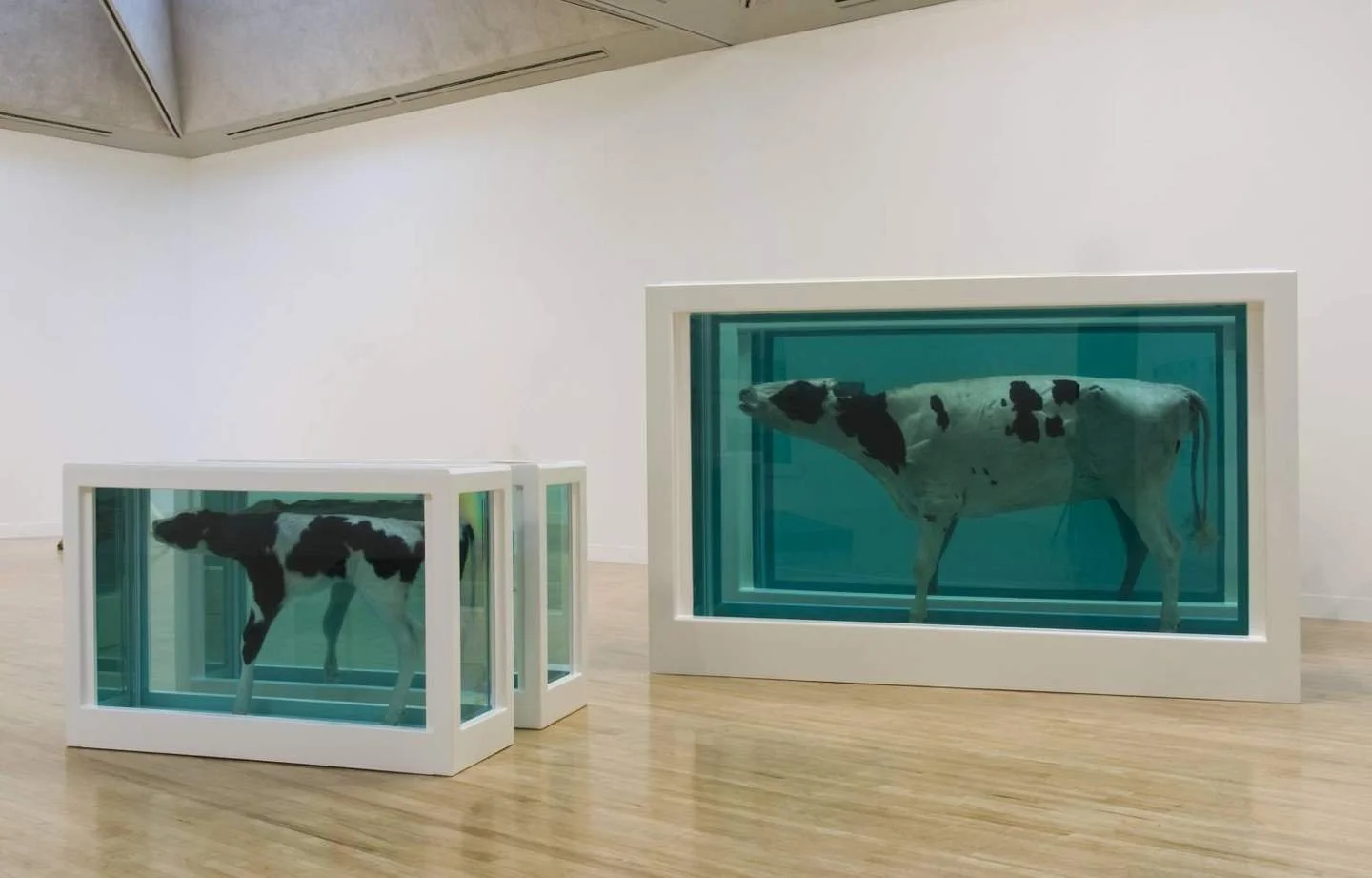
Mother and Child Divided
And then the dots and the spins. This is where I just fall off the cliff.
Because these are not complex objects. They’re not even complicated objects. They’re basically a system. Dots. Or a canvas on a spinner with paint poured on it for a few seconds. That’s it. And sure, you can wrap it in a nice conceptual sentence about chance and authorship and blah blah blah. But the honest material reality is, these things are insanely easy to produce. They’re perfect for scale.
And the part that makes it gross is how smart it is, market-wise.
If you sell a few at high prices, then you can flood the market and still ride the aura of “Hirst.” People want one because Hirst is a signal. It’s something you can hang and it broadcasts that you’re plugged in. Some people genuinely like them, fine. But a lot of buyers are buying into the storyline. Buying into the price trajectory. Buying into the idea that it keeps going up because it has been going up.
At that point, the “art” is almost secondary. The real artwork is the market behavior.
And then once enough people have spent enough money, the market becomes defensive. Because now there are people with real exposure. People who can’t afford for the thing to collapse. So the price gets supported. Maybe not formally, but functionally. Somebody steps in. Somebody makes sure it doesn’t look weak at auction. Somebody makes sure the chart keeps pointing up.
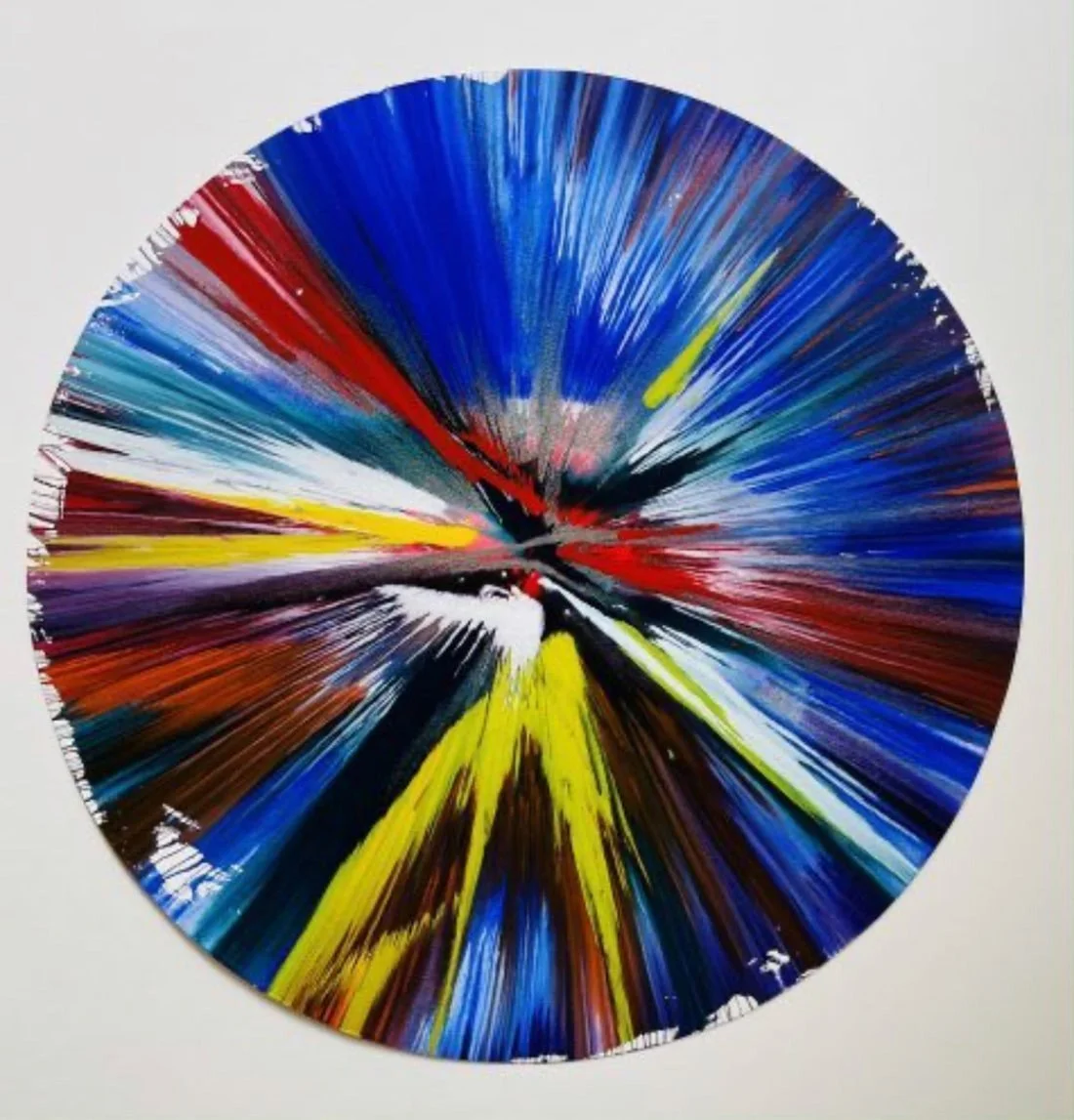
Hirst Spin Painting
It starts feeling less like a culture and more like a managed financial product. Not exactly a conspiracy. More like momentum plus self-interest. Which is how bubbles work. Everyone knows it’s ridiculous, but nobody wants to be the first person to admit it out loud while they’re holding the bag.
I’m not hurt by this art. What I actually feel is more like awe. The fact that Hirst can make more than a thousand versions of the same spin painting, and still sell them—some for a million dollars or more—is incredible. Because it’s not about the painting anymore. It’s about the structure that makes that possible. The studios, the collectors, the galleries, the auctions, the brand.
Then you get the authorship and appropriation mess that hangs around Hirst and Koons. The feeling that the line between “influence” and “taking” gets blurry, and the line between “artist” and “factory” gets blurry too. Teams of assistants, production lines, found images, photo-based work. That whole ecosystem makes me uneasy because it doesn’t feel like it’s about looking anymore. It feels like it’s about output.
Being an artist with a team of support helping you work is not new. This is a practice that has gone back to the Renaissance era. However now we have people like Koons and Hirst who I am not sure even know how to paint. They are sort of like Steve Jobs who is great at the ideas and marketing but not the people actually doing the work. Steve Jobs was not a developer, Hirst and Koons are not painters.
“Ethel Scull 36 Times” 1963 painting by American artist Andy Warhol.
A lot of this goes back to Warhol I think. Warhol was famous for a lot of things, one of them being his method of portraiture. There is a famous tale of Warhol taking a wealthy socialite who wanted a portrait of herself to a photo booth where he said ‘pay me, take a set of photos and give them to me’. She gave warhol the cash, a strip of photos, Warhol took the strip of photos to his silkscreening factory and asked them to turn the pictures into a portrait based on the ‘warhol’ style. DOne.
… more coming. Still working on this.

“Ethel Scull 36 Times” 1963 painting by American artist Andy Warhol.